- Home
- Products
- One-stop Solution
- Setting Up An Operating Room
- A Guide to Labour Room Equipment
- What Equipment is Used For OB/GYN Exam Room?
- The Most Popular Medical Ward Furniture List
- Tactical Military Medical Supplies
- Neonatal Care Equipment:Neonatal Intensive Care Unit
- Essential ICU Equipment List For All Hospital
- Essential Equipment in For Every Veterinary Clinic
- Video
- WHY CHOOSE US
- News
- Contact Us
- Strive to Improve Medical Conditions, Reduce Health Care Costs.

Location
Zhangjiagang City, Jiangsu Province, China.
Email address
Phone
+86-512-58810663
What are the precautions for using the KED device?
Time:2025-06-19
At the first aid scene, especially in situations where there is a risk of spinal injury such as car accidents or falls from heights, the KED (Kendrick Extrication Device) is often used to stabilize the patient’s head, neck and spine, and help safely transfer the injured in a small space. However, although the KED is a very effective first aid tool, it is not suitable for all emergency situations. Understanding its applicable population and contraindications is the key to ensuring the safety and efficiency of first aid.
What is the KED device?
The KED is an emergency backboard made of a flexible semi-rigid material with multiple adjustable straps. It is designed to stabilize the head, neck and spine of the injured, and is particularly suitable for fixing and transporting injured people at car accident sites, in confined spaces and in sitting positions.
Applicable population and typical application scenarios of KED
KED is mainly used for primary fixation in the following situations:
Seated patients suspected of spinal injury
For example: car accident scene, sitting comatose patients after falling.
Situations where long backboards cannot be used directly in small spaces
Such as cockpits, toilets, corners of stairs and other places with limited space.
Conscious and highly cooperative adult patients
The patient can understand the operation process and cooperate with emergency personnel to complete the fixation process.
For preventive fixation of spinal injuries
Especially when strict requirements are placed on the patient’s posture before transfer.
Contraindications and situations where KED is not recommended
Although KED is widely used, it is not recommended or should be used with caution in the following situations:
Patients with dyspnea or airway obstruction
KED may constrict the chest cavity and affect the patient’s normal breathing, especially those with multiple trauma or lung injuries.
Patients with unconsciousness or coma
Due to the high difficulty of cooperation and long rescue time, it is easy to delay treatment or cause secondary injuries.
Extremely unstable patients with multiple trauma
Such as massive bleeding, hemorrhagic shock, severe fractures, etc., should be transported quickly first, and time-consuming fixation is not appropriate.
Situations requiring emergency cardiopulmonary resuscitation
KED limits chest compressions, CPR cannot be performed effectively, and flatbed transport should be selected immediately.
No special models are used for children or patients with special body shapes
Adult KED size is not suitable for children, and improper use may have a counterproductive effect.
Alternatives and emergency judgment suggestions
In contraindications, the following should be selected according to the patient’s condition and on-site conditions:
Long backboard (Spine Board)
Soft stretcher or vacuum splint
Direct rapid transfer (Load & Go) strategy
First aid personnel need to quickly assess the patient’s condition and choose the safest and most effective fixation and transfer method.
Rational use of KED to improve rescue quality
The KED device can effectively reduce the risk of secondary spinal injury in appropriate use scenarios, but it is not a “universal tool.” Only by clarifying its scope of application and contraindications and making flexible judgments based on the patient’s condition can its clinical value be truly brought into play. For emergency personnel, mastering the operating skills, judgment criteria and alternatives of the KED is the basis for every emergency decision.
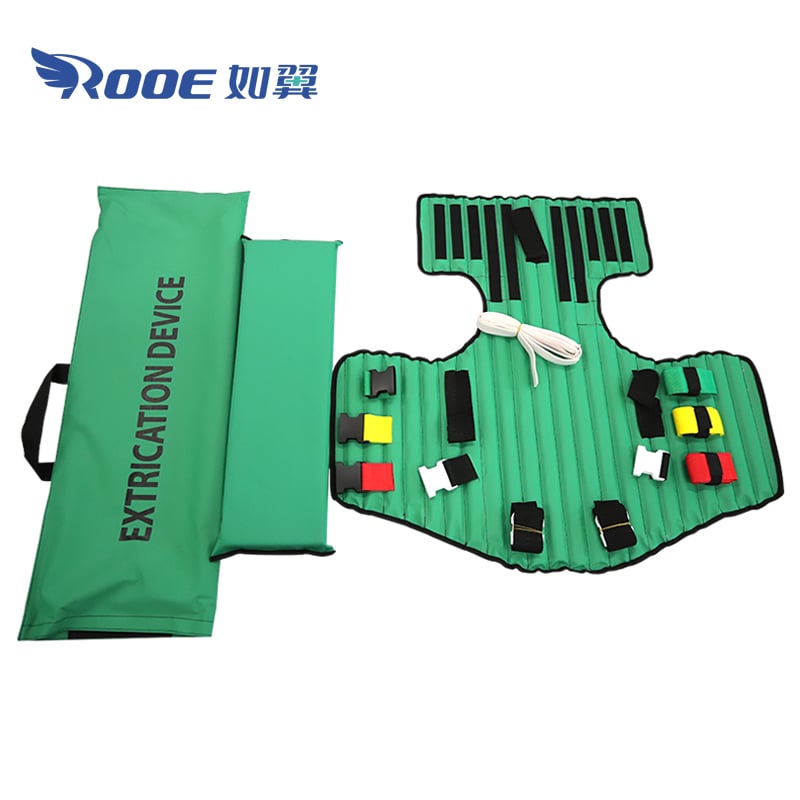 |
 |
| EB-3A KED | EB-3A Pediatric KED |
Leave a Reply